

Flame-retardant carpets: Regulations and material solutions
 Angelina Schöffel
updated: 18 September 2026
5 minutes reading time
Fire protection for carpets presents particular challenges due to their fibres. However, certain additives such as expandable graphite can be incorporated directly into the backing to make carpets flame-retardant.
Topics at a Glance
Key Facts
- Flame-retardant carpets in commercial and public buildings generally need to meet class Cfl-s1 or Bfl-s1 according to DIN EN 13501-1.
- Flame retardants such as expandable graphite can be worked directly into the carrier system of the carpet’s backing, without altering the yarns themselves.
- Thanks to the intumescent effect of expandable graphite in the carpet backing, a protective carbon layer forms under heat which blocks oxygen, helping to prevent the spread of fire through the carpet.
Fire protection for textile floor coverings
Flame-retardant carpets aren’t just recommended but are often legally required in many public and commercial buildings and in transport. The reason is that textile floor coverings behave fundamentally differently in fires compared to hard floors. Tiles or screeds are made from mineral components and are barely flammable. Carpets, on the other hand, generally consist of combustible fibres and a backing which often contains additional flammable components, actively increasing the fire load in a room.
The strictness of fire protection requirements depends on the building type. Normally flammable material is sufficient for private homes, as there are hardly any special requirements there. However, as soon as lots of people gather or escape routes become longer and more complex—as in hotels, cinemas, assembly halls, high-rise buildings, schools or offices—much stricter rules apply. The strictest standards are imposed where it isn’t easy to leave a burning room, for example in trains or aircraft.
Regardless of whether the application is a building or a vehicle, the principle remains the same: to meet legal requirements, ideally fire safety should be considered during production. The key difference is the material composition—either via inherently flame-retardant fibres, the addition of certain flame retardants, or special coatings.
Fire safety standards for carpets
DIN EN 13501-1 is the harmonised European standard for classifying the fire behaviour of construction products and building materials. The standard divides products into six classes, A to F—with the extension "fl" for flooring for floor coverings. In addition to fire behaviour, it also rates smoke generation: s1 for low and s2 for higher smoke production. For carpets, only three classifications are relevant in practice: Efl, Cfl-s1 and Bfl-s1. Afl is reserved for non-combustible flooring such as stone or ceramic. Ffl represents easily flammable floor coverings, which must not be used in building construction regardless of their material. Dfl requires similar standards to Efl and, in practice, isn’t a separate category for carpets, as textile floor coverings reach at least Efl as standard.
Efl – for normally flammable carpets

Cfl-s1 – for flame-retardant carpets
Bfl-s1 – for especially demanding escape routes
Note: The previous fire protection assessment according to DIN 4102 with B-classes has been replaced by the European DIN EN 13501-1. Cfl-s1 and Bfl-s1 largely correspond to the old B1 class, with updated smoke production ratings.
Requirements for textiles in means of transport
If textile floor coverings are fitted not in buildings but in items such as vehicles, other standards apply. For rail vehicles such as trains, this is EN 45545-2, which specifies its own test criteria and classifies products based on hazard levels. These depend on how quickly passengers could evacuate in an emergency: the longer an evacuation is likely to take, for instance in tunnels or sleeper trains, the stricter the requirements. The standard also differentiates between different components and materials via specific requirement sets, with floor coverings and carpets having their own category.
What makes carpets flame-retardant?
When talking about a fire protection carpet, this usually means it is flame-retardant. There are three ways to achieve this, depending on whether flame-retardancy is built into the fibre itself, incorporated during production, or applied to the finished carpet.
- Flame retardancy in the fibre: Here, the fire protection is intrinsic. Wool is naturally flame-resistant, as it tends to char rather than melt under heat, and it needs more oxygen than is available in room air to burn. In synthetic fibres such as Modacryl or Trevira CS, flame retardants are chemically bonded within the polymer so that protection remains even after frequent cleaning.
- Flame-retardant additives: Certain compounds are integrated directly into the fibre during production or applied as a coating to the backing. These include phosphorus and nitrogen compounds, as well as expandable graphite—a popular natural additive for fire protection.
- Carpet impregnation: This method treats the finished carpet by spraying or applying flame retardants later. It is particularly suitable for temporary use, such as at trade shows or for stage decoration, as the coating may be washed away during cleaning.
The carpet backing as the key to fire protection
For many areas, the carpet backing is the best way to meet fire safety requirements. Since a carpet has several layers—the visible wear layer and the stabilising backing beneath—the carpet can be upgraded with flame retardants no matter which fibre is used, without altering the look or feel of the surface. However, this does not mean the surface fibres cannot burn—they may scorch or briefly catch fire even if the carpet is flame-retardant. What matters is how the fire behaves afterwards—whether it spreads or self-extinguishes. This is where the backing comes in, as it can prevent a fire from continuing through the entire carpet.
Materials for fire safety coatings
For years, aluminium hydroxide (ATH) has been the standard flame retardant for backings, releasing chemically bound water under heat which draws energy from the coating and reduces temperature. For this effect to be significant, ATH must be used at relatively high concentrations, which increases the carpet’s weight and can complicate processing. A highly effective alternative is graphite—more specifically, expandable graphite. It acts differently to ATH: it expands under heat to many times its original volume, forming an insulating carbon layer that blocks oxygen. Since this effect works at lower dosages, expandable graphite can be a gentler solution for the carpet backing.
Incorporating expandable graphite into the carpet backing
If a manufacturer chooses expandable graphite as a flame retardant, the key question is how to process it into the backing. Expandable graphite can be used alone, as the main fire retardant, or as a synergist in combination with other agents. For carpet backing, it’s usually mixed as an additive into an existing binding medium, such as latex, polyurethane (PU), or water-based systems. This mixture is applied to the back of the carpet. Several factors influence precise processing:
- Particle size: The finer the particle size of expandable graphite, the more it affects the viscosity of the binding system.
- Coating thickness: The thickness of the backing layer influences how finely the graphite must be ground.
- Loading rate: For carpet backings, a relatively high loading rate is typical, but this depends on the chosen system, application, and required fire safety class.
Since expandable graphite is simply blended into the binding agent already in use, it can usually be integrated into existing manufacturing with minimal changes.
Why graphite is convincing in carpets
Expandable graphite is an intumescent flame retardant. When exposed to heat, it doesn’t burn, but expands greatly—depending on the type, up to 600 times its original volume. This forms a carbon layer that acts as a barrier to both air and oxygen from the environment. Graphite itself doesn’t create a flame and smothers itself once heat is removed. This is exactly what makes expandable graphite an effective basis for flame-retardant carpets. The material also brings several other advantages:
- Halogen-free flame protection: Expandable graphite does not require halogenated additives, making it a relatively eco- and health-friendly option.
- Low smoke emission: The resulting carbon layer can help release less smoke in a fire.
- Discreet appearance: Because the dark grey graphite is confined to the adhesive layer, leaving the visible surface unchanged, it’s also suitable for high-quality, design-focused textile coverings where appearance and feel matter.
- No abrasion: The graphite is locked in cured latex or adhesive—it does not dust off in daily use, is not lost when vacuuming, and remains fully effective for decades.
Application example: Carpet in trains
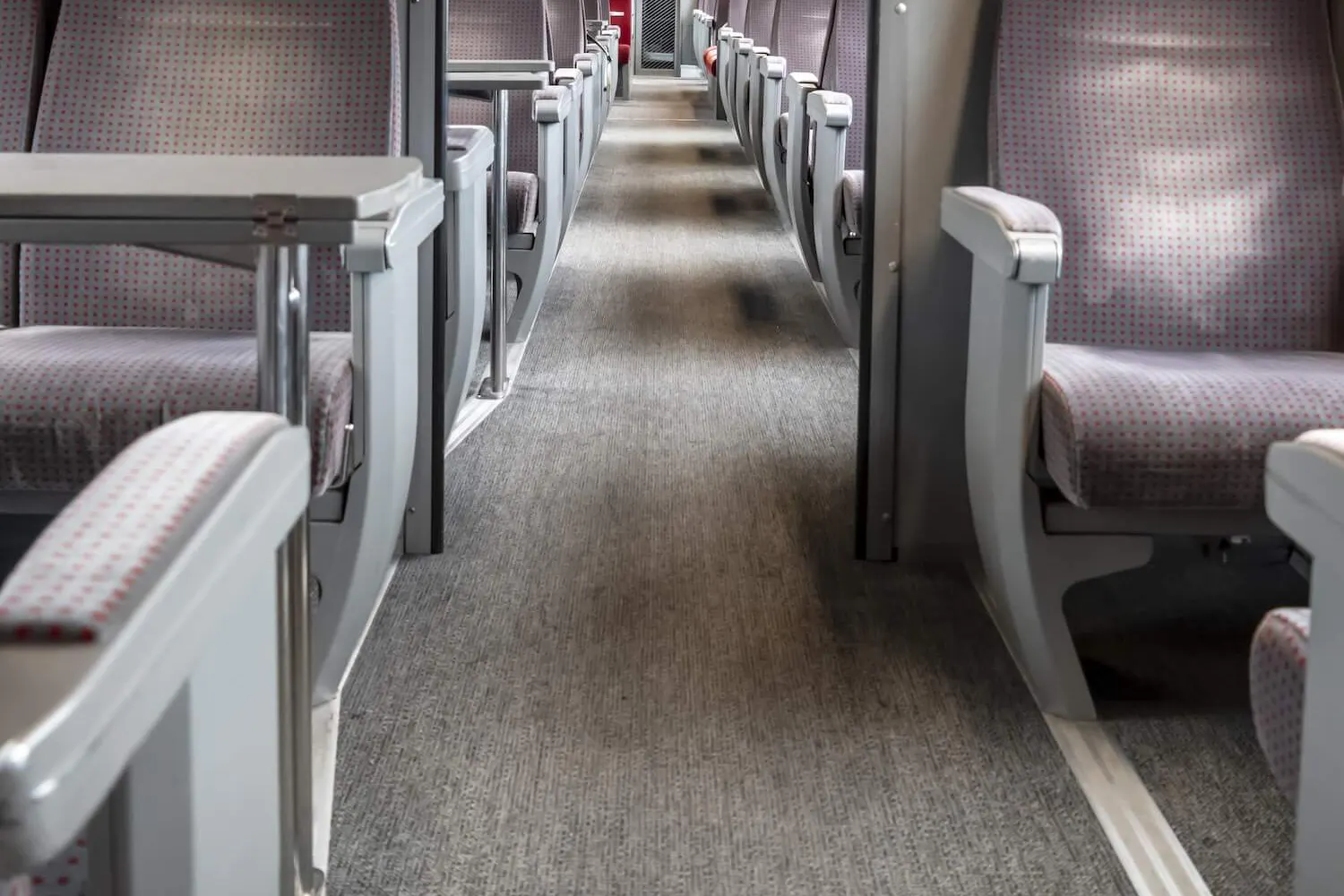
Most regional trains use hard, resilient flooring such as vinyl or PVC for robustness and ease of cleaning. Long-distance trains, on the other hand, often use carpets, which provide noticeably more comfort, reduce footfall noise, and offer a higher-quality feel than rigid flooring. On long journeys, this can make a real difference to passenger comfort. But since carpets in trains are safety-relevant components, the strict fire protection requirements of EN 45545-2 must be met.
To provide the required protection, expandable graphite can be integrated into the carpet backing without compromising comfort or design. In a fire, the graphite creates a protective carbon layer, slows down fire spread, and gives passengers valuable extra time. Carpets aren’t the only material that can be protected with expandable graphite; for example, it can also be used for seats. More details are available in our article on expandable graphite in seat foams.
Finding the right solution
Not every fire-retardant carpet is suitable for every application, as the solution depends on standards and requirements. To find the best option, you should start by considering three key points:
- Location: Will the flame-retardant carpet be used in a building or, for example, in a rail vehicle?
- Certification: Which test certificate is required?
- Halogen-free: Is the flame retardant halogen-free and compliant with current regulations?
To fulfil these requirements, we at LUH use expandable graphite as an additive for carpet backings. We support manufacturers from the initial idea through to the finished formulation. In our own laboratory, we develop bespoke expandable graphite specifications, tailored to individual applications and current regulations.