

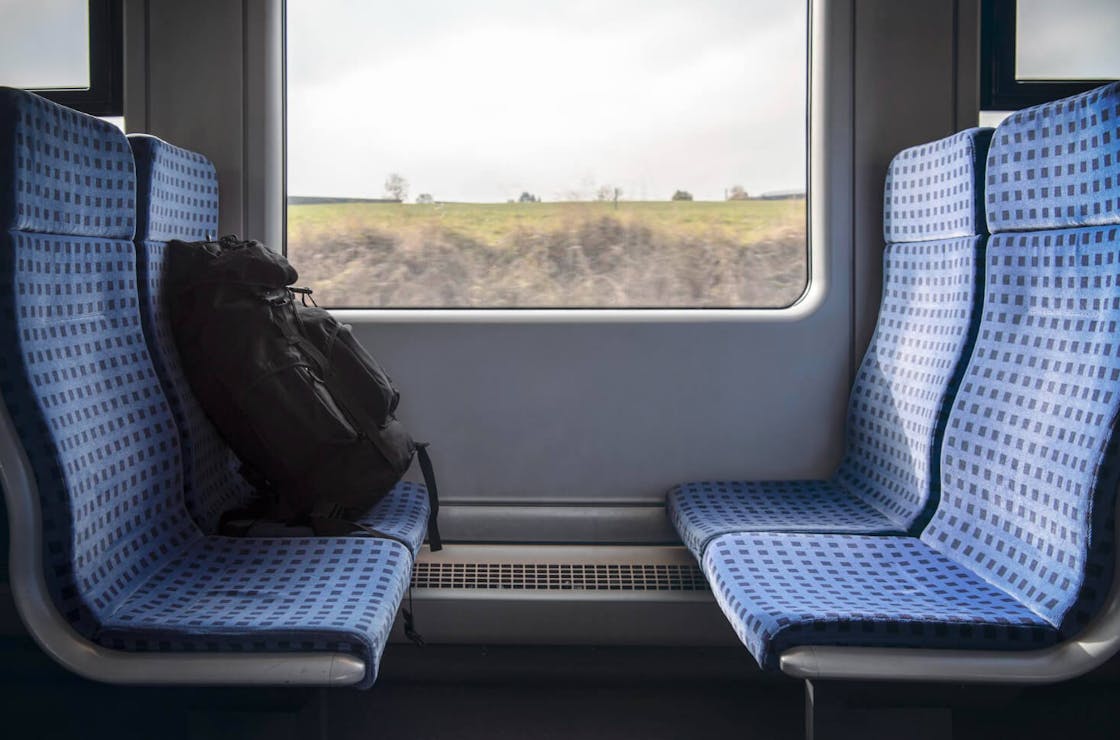
Fire protection in rail vehicles: Expandable graphite in seat foams
 Christian Conrad
updated: 22 September 2026
5 minutes reading time
Fire safety on the railway is about more than regulations, it's about everyday safety. In this post, we show how seat foams with expandable graphite can meet the rigorous requirements of EN 45545.
Topics at a Glance
Key Facts
- The European standard EN 45545 specifies strict requirements for materials used in trains, such as seats, paneling, and cables.
- Polyurethane seat foams in particular are highly flammable without additives and therefore require suitable flame retardant solutions.
- Expandable graphite acts as a halogen-free flame retardant additive that forms a protective insulating layer in the event of a fire, without producing toxic fumes.
Fire protection in rail vehicles – why is it so important?
In a moving train, every second counts in the event of a fire. Unlike buildings or cars, rail vehicles do not have fast escape routes, nearby emergency exits, or immediate external assistance. Especially when travelling through tunnels or on long stretches where immediate evacuation isn’t possible, passengers rely on the best possible proactive fire protection. That’s why particularly strict regulations apply to trains, affecting not only construction but also the materials used.
The aim is to prevent the outbreak of a fire as much as possible and, should one occur, to slow its spread, minimise smoke build-up, and avoid toxic gases. Fire protection in rail vehicles is therefore not just a technical matter, but a question of responsibility towards the people travelling by rail every day.
The EN 45545 Standard: Uniform fire protection across Europe
If you board a train in Europe, you can be sure: fire safety is standardised. EN 45545 is the European standard when it comes to safe travel in rail vehicles. It precisely specifies what materials can be used in which areas and how they must behave in the event of a fire.
What exactly does EN 45545 regulate?
- Flammability: How easily does a material catch fire?
- Smoke density: How much smoke is produced in case of fire?
- Toxicity: How hazardous are the gases produced?
- Self-extinguishing: Does the material extinguish itself after ignition?
Classification into HL classes
- HL1: Lowest risk (for example, with short use or good evacuation possibilities)
- HL2: Medium risk (common with regional trains or trams)
- HL3: Highest requirements (for example, with tunnel journeys or sleeper trains)
EN 45545-2: The relevant part for materials
The most important section for manufacturers is EN 45545-2. This part defines the exact test methods and performance requirements for the fire behaviour of materials, including foams for seat cushions or wall panelling.
For each application, there are defined limit values that must be checked by special tests. Only if a material meets all the requirements may it be used in rail vehicles.
Key test procedures include, for example:
- ISO 5660-1 (Cone calorimeter): Determining heat release and ignition behaviour
- ISO 5659-2: Determining smoke density (optical smoke density Ds)
- ISO 11925-2: Test for ignitability during direct flame exposure
From rule book to reality: what this means for seat foams
All this sounds technical, but it has very real implications. EN 45545 doesn’t just apply to floor coverings, wall panels, or cable ducts, but also to the cushions we sit on in the train every day. The right material is especially important for seat foams. They are usually made from polyurethane (PU), which, without additives, is easily flammable and can quickly release dangerous smoke gases in a fire.
To ensure these foams meet the EN 45545 requirements, clever, halogen-free additives are required. A proven solution is our expandable graphite as a flame retardant in PU foams, which foams up in the heat to form a protective barrier.
Expandable graphite in seat foams: Intelligent fire protection for rail vehicles
Seat cushions in trains are among the most heavily used components, subjected to passengers, changing temperatures and, of course, strict fire protection requirements. High demands are placed in particular on flame resistance, smoke development and fire behaviour in intercity, regional or high-speed trains. This is exactly where our expandable graphite as a halogen-free flame retardant comes into play.
And with good reason, conventional flame retardants are increasingly criticised: many contain substances that are harmful to health or even toxic – a real risk, especially in enclosed passenger compartments. In our blog post about toxic flame retardants we highlight which substances are problematic and why mineral alternatives like expandable graphite are a safe choice.
How does expandable graphite work in seat cushions?
Seat cushions are usually made of soft polyurethane foam, a material that is easily flammable without measures. If expandable graphite is added to the foam, however, the fire behaviour changes fundamentally. The graphite remains completely stable in normal conditions – but in an emergency, meaning under intense heat, it begins to react: it expands.
This intumescent reaction means that the expandable graphite swells up to many times its original volume. What forms is a carbon-rich, protective barrier directly on the surface of the foam. This layer:
- inhibits the admission of oxygen,
- reduces heat transfer,
- slows the ignition of the material,
- and prevents the fire from spreading further.
Technical implementation in foam production
Expandable graphite is incorporated during the production of PU seat foam, usually mixed directly into the polyol component of the two-component system. When mixed with isocyanate, the graphite disperses evenly throughout the material. This creates comprehensive and long-lasting fire protection that remains effective throughout the entire service life of the seat.
Processing is usually done by low-pressure methods, though increasingly by high-pressure processes as well, particularly for large components like seat cushions or headrests in series production, bringing efficiency benefits.
Why expandable graphite is the ideal solution
- Halogen-free & non-hazardous to health: Expandable graphite is a pure, mineral additive, with no halogens, no toxic residues and REACH-compliant.
- Effective & reliable: Even small amounts provide a drastic reduction in heat release during a fire.
- Stable & durable: Unlike gaseous additives, expandable graphite remains in the material for many years.
- Recyclable & environmentally friendly: The use of expandable graphite does not restrict the foam's recyclability.
- Versatile applications: In addition to seat cushions, expandable graphite can also be used in backrests, armrests, and PU panelling elements – anywhere design and safety are required together.