

/Magazin
The most important properties of graphite
In this article, you'll learn all about the remarkable properties of graphite – from its unique electrical and thermal conductivity to its high temperature and corrosion resistance.
Graphite at a glance
Graphite is a naturally occurring mineral and one of the most stable forms of the chemical element carbon. Although it may appear unremarkable at first, a closer look reveals its enormous technological and industrial potential. Due to its unique properties, graphite is suitable for a wide range of industrial applications – from a classic raw material to a high-tech material.
Natural graphite
Formed through geological processes and naturally possesses specific material characteristics.
Synthetic graphite
It's industrial production allows precise control over its structure and composition.
Optical properties of graphite
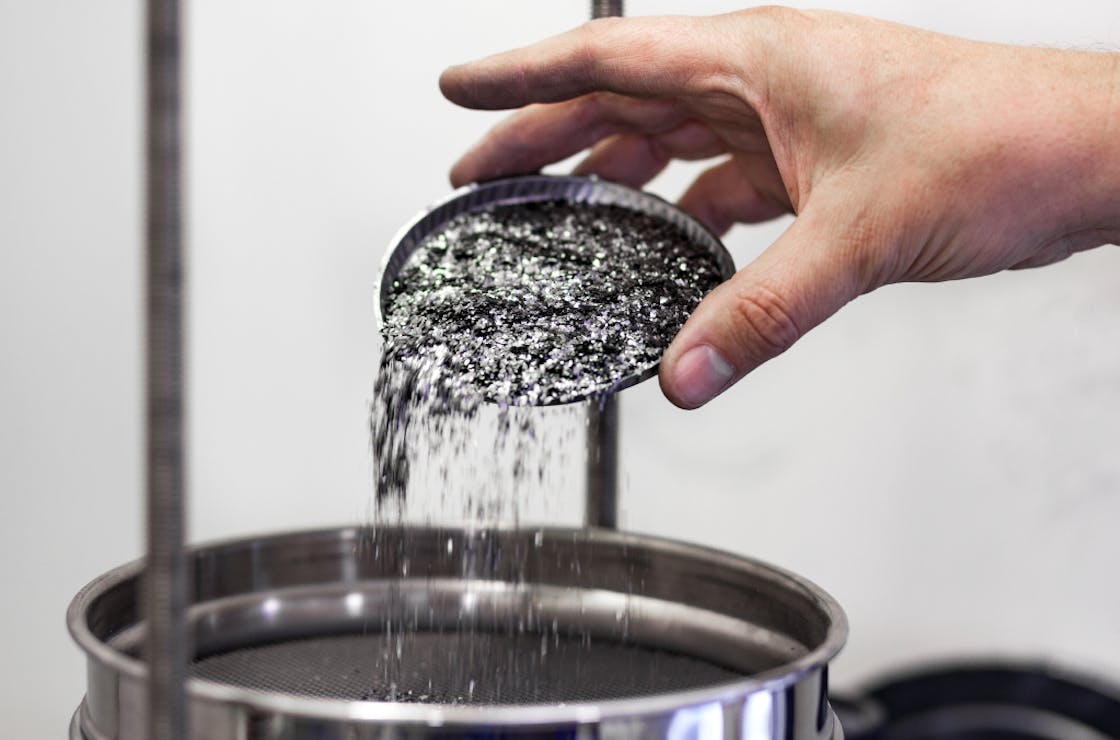
Graphite ranges in colour from light grey to deep black. It is characterised by a silvery to metallic sheen, particularly visible in its dense or crystalline forms. The structure of graphite is layered: the carbon atoms are arranged in flat, hexagonal sheets, giving the material a lamellar, sometimes flaky appearance. For natural graphite, there are two main types:
- macrocrystalline: with a clearly visible crystal structure and shiny surface
- microcrystalline (amorphous): fine-grained, matt and more visually homogeneous.
Physical properties of graphite
Graphite is one of the relatively lightweight materials, especially compared to metals. This makes it particularly interesting for applications where low weight is crucial, such as in electromobility, battery production or within New Energy sectors.
The density of graphite depends on its internal structure, production method, and whether it is natural or synthetic. The density of natural graphite typically ranges from 2.1 to 2.3 g/cm³.
Technical properties of graphite
Electrical and thermal conductivity
One of the most remarkable properties of graphite is its unique combination of electrical and thermal conductivity. How effectively graphite conducts electricity or heat depends on the material’s characteristics and whether it is used in pure form or in compounds. For compounds, the conductivity can vary from antistatic to conductive, depending on the filler percentage.
Pure graphite typically achieves electrical conductivities in the range of 10³ to 10⁴ S/m. Its thermal conductivity is also impressive, reaching up to 140 W/mK in its pure state. The values are lower in graphite-filled compounds but can be precisely adjusted. Even with a filler content of around 20 per cent, thermal conductivities of about 2 W/mK are possible, with maximum values of 20 to 25 W/mK achievable at higher concentrations.
This makes graphite especially suitable for applications where a combination of electrical and thermal conductivity is needed and effective heat management is essential.
Temperature resistance
Graphite stands out not only for its excellent thermal conductivity but also for its exceptionally high temperature resistance. In an oxygen-free environment, graphite remains stable even at temperatures in excess of 3000 degrees °C, making it one of the most temperature-resistant materials available. This extreme heat resistance makes graphite an ideal material for high-temperature applications.
Graphite is also considered non-flammable. This property, combined with its high temperature resistance, makes it attractive for use in fire protection. Especially as a halogen-free flame retardant, graphite helps reduce the flammability of materials and control heat exposure.
Thermal expansion and exfoliation
In specific forms, graphite can expand significantly. Expandable graphite begins to increase its volume dramatically at temperatures around 180° Celsius. A foam-like protective layer forms, creating a barrier: it prevents oxygen from reaching the substrate and reduces the heat affecting the underlying material. Thanks to this intumescent layer, expanded graphite serves as an effective flame retardant and presents an environmentally friendly, safe alternative to brominated flame retardants. The combination of high temperature resistance, excellent thermal conductivity and active fire protection makes graphite a versatile additive with significant safety relevance.
Corrosion resistance
Graphite is not only highly resistant to heat but also to chemical influences. A key property of graphite is its pronounced corrosion resistance: graphite exhibits remarkable resilience against many acids, alkalis, and oxidising agents, maintaining its integrity even in demanding environments.
Lubricating and releasing ability
Thanks to its characteristic layered structure, graphite also provides outstanding lubricating and release properties. The individual carbon layers are only loosely bonded and can easily slide over each other. This creates a natural glide surface that maintains its effect even under mechanical stress or at elevated temperatures. Its low coefficient of friction ensures excellent glide properties and minimises the wear of surfaces in contact. This makes graphite an effective lubricant that enables smooth, low-friction separation of surfaces, even without additional lubricants such as oils or greases.
Huge potential in a raw material
Graphite has proven its worth in a wide range of industrial applications. Its exceptional combination of properties makes this raw material indispensable in many engineering fields – as a functional additive in plastics, a thermally conductive component in electronics, or a stable lubricant for high-temperature processes. Graphite combines several high-performance characteristics in one substance:
- High electrical conductivity
- Excellent thermal conductivity
- Extreme temperature resistance
- Outstanding corrosion resistance
- Excellent lubricating and release properties
This versatility enables graphite to be used precisely where conventional materials reach their limits. The result is efficient, reliable, and durable solutions for demanding applications.
Are there differences in the properties of natural and synthetic graphite?
The properties of natural and synthetic graphite can differ to some extent, particularly in terms of purity, crystal structure or particle shape. Which variant is best depends on the specific application. Both types of graphite have their particular strengths. You can find a detailed comparison in our article: Synthetic Graphite vs Natural Graphite: A Comparison.
LUH – Your partner for natural graphite
We know and value the properties of graphite, especially natural graphite. As an experienced specialist for industrial applications, we understand precisely how to harness the potential of this unique raw material. Whether as a halogen-free flame retardant, in high-performance fire protection systems or in precise conductivity applications – we develop and supply bespoke solutions tailored exactly to your requirements. We support you from concept to delivery with our expertise and our passion for natural graphite.