

/Magazin
Why Graphite plays a key role in conductive compounds
Conductive compounds are relevant for a wide range of applications that require both electrical and thermal conductivity. We explain the benefits of graphite as a filler in plastic compounds.
Short Overview
Compounds are used to specifically adapt plastics to technical requirements. By combining polymers with special fillers, properties such as conductivity, weight, stability or resistance can be precisely controlled. Different additives are used depending on the application. Graphite plays a special role here, as it enables both thermal and electrical conductivity, thus offering functional, high-performance plastic solutions.
Electrical Conductivity
For controlled dissipation of electric charges and defined conductivity.
Thermal Conductivity
For targeted heat dissipation and protection against overheating of components.
What are conductive compounds?
Conductive compounds are plastics whose properties are specifically altered and improved by adding special fillers. In their original state, most plastics are not very conductive, neither for electricity nor heat. However, to make them suitable for technical applications, they are combined with functional additives during the compounding process. Various fillers can be used, depending on the required property:
- Carbon black for electrical or antistatic plastics
- Metal powder for applications where high conductivity is more important than low weight
- Carbon fibres for electrical conductivity and mechanical strength
- Aluminium oxide for good thermal conductivity combined with electrical insulation
- Boron nitride for thermal management applications
- Graphite for very high, simultaneous thermal and electrical conductivity
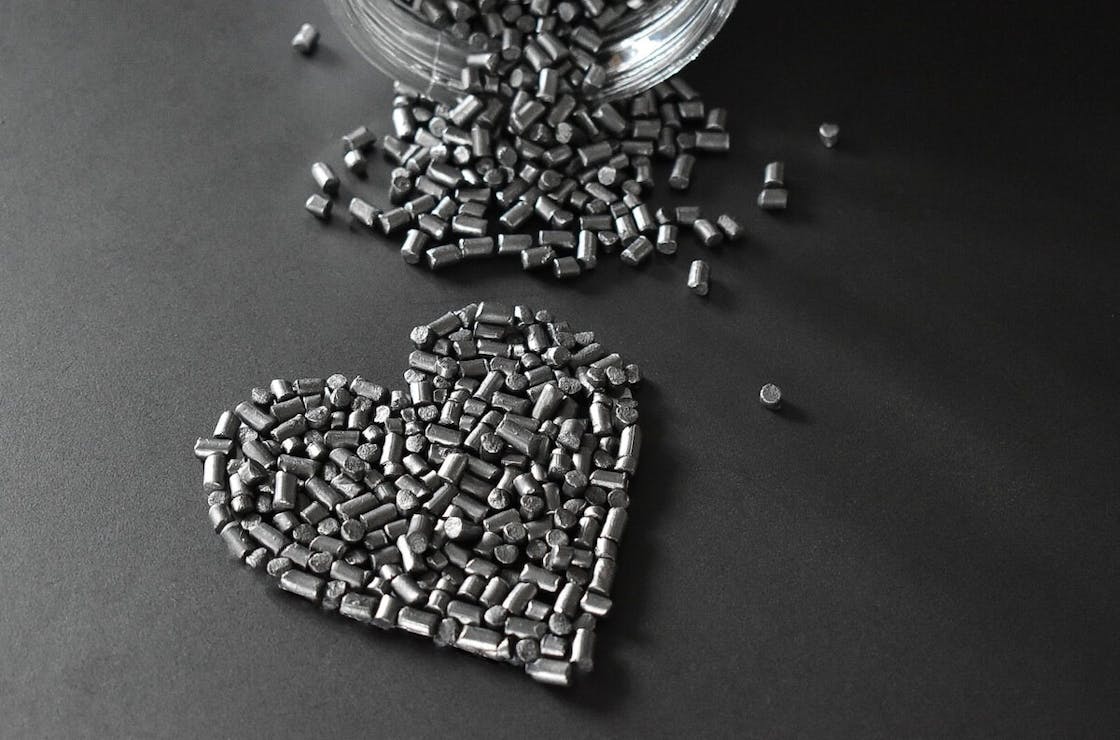
Compounds are not a single component or a finished product, but a homogeneous plastic granulate that can later be processed further easily and with minimal dust. Visually, they usually look like small cylindrical or lens-shaped plastic pellets – similar to conventional granulates, just with specifically engineered material properties.
How conductivity is achieved in compounds
The conductivity of compounds is achieved by the targeted addition of conductive fillers, which are evenly distributed in the plastic during the compounding process. Most of these are microscopically small particles, fibres or plate-like structures that form a continuous network within the plastic. The originally insulating plastic acts as a carrier material, while the fillers provide the conductive properties. This way, non-conductive plastics can be functionally enhanced and made suitable for technical applications.
Types of conductive compounds
Conductive compounds can generally be divided into three main types, depending on which functional property is required for the application.
- Electrically conductive compounds: Efficiently dissipate electrical charges to prevent static build-up.
- Thermally conductive compounds: Specifically transfer heat away from hotspots to protect components from overheating.
- EMC compounds: Provide shielding against electromagnetic interference.
Graphite as a conductive filler
Graphite is one of the most important conductive fillers in compounds. Thanks to its plate-like structure, graphite can form especially well-connected networks within the plastic, allowing heat to be transferred efficiently. Pure graphite has a very high thermal conductivity of about 140 W/(m·K). This potential is utilised in plastic compounds, although the achievable thermal conductivity is naturally lower than that of pure graphite because the graphite is embedded in a non-conductive plastic. At the same time, the thermal conductivity of graphite-filled compounds can be precisely and reproducibly tailored, particularly by varying the filler content and selecting the type of graphite used, enabling application-specific thermal management solutions to be implemented.
Graphite also has an electrical conductivity of about 10³ to 10⁴ S/m. In electrically conductive compounds, graphite can make an important contribution to the controlled dissipation of electrical charges or setting defined electrical conductivity within plastics. Here too, both the filler content and the type of graphite used significantly influence the resulting electrical conductivities of the compounds.
The advantages of graphite in compounds
Compared to metals or other conventional fillers, graphite offers a number of compelling advantages. These make it a versatile filler for plastic compounds and particularly suitable for a wide range of technical applications.
Lower weight
Graphite is significantly lighter than other conductive materials such as metals. When used as a filler in compounds, it enables the production of weight-efficient components without sacrificing functional properties like thermal or electrical conductivity.
Temperature stability
Graphite-filled conductive compounds exhibit reliable conductivity even at very high temperatures. Natural graphite is extremely heat-resistant and remains stable at temperatures up to 3000 °C in an oxygen-free environment. When combined with plastics, this property can be used to develop thermally conductive compounds that retain their function under demanding conditions. While metallic fillers tend to oxidise or change properties at high temperatures, and carbon black only offers limited thermal conductivity, graphite helps increase the thermal stability and operational safety of compounds even under continuous heat exposure.
Corrosion resistance
In addition to its thermal stability, graphite is also highly resistant to numerous chemical and environmental influences. This property in compounds helps reliably protect components from aggressive substances and environmental factors. Thanks to its high corrosion resistance, the electric and thermal conductivity remains stable even when components come into contact with acids, alkalis or moisture.
Flexibility
Thanks to their excellent processability and easy formability, graphite-based conductive compounds offer great flexibility and design freedom. Compared to conventional conductive materials, plastics with graphite-based fillers can be shaped into almost any form. This means even complex and demanding conductivity requirements can be specifically implemented and adapted to meet technical specifications.
Improved acoustics
Compared to metallic materials, graphite compounds display significantly better damping characteristics for vibrations and noise. The combination of plastic and graphite usually allows for effective reduction of vibrations and structure-borne sound. This property is particularly useful in technical applications to minimise noise development and improve the smooth operation of components.
Sustainable material solution
When natural graphite is used, conductive compounds also offer sustainable advantages. Natural graphite is a mineral resource that is obtained without complex chemical synthesis, offering a more resource-efficient alternative for many conductivity applications. Graphite is an environmentally friendly, mineral-based material that is halogen-free. The graphite we use in compounds also meets the requirements of the REACH regulation.
What does the filler content of compounds mean?
The filler content describes the proportion of conductive fillers in the plastic compound and is a decisive parameter for precisely tailoring material properties. Thermal and electrical conductivity, as well as processability and mechanical characteristics, can be influenced depending on the filler content. This enables conductive compounds to be produced precisely for the intended application.
For example, there are graphite compounds with very high filler contents of up to 90% by weight, achieving thermal conductivities of over 20 W/(m·K). Despite this high proportion, these compounds can still be processed easily and exhibit only a minor impact on mechanical properties. In other applications, lower filler contents are required. By using ultrathin graphite particles, thermal conductivities of over 2 W/(m·K) can already be achieved at graphite concentrations of about 10 to 30%. The filler content can also influence the electrical conductivity, so this can be precisely adjusted from antistatic to electrically conductive. The required filler content thus depends on the desired properties and the respective application.
Where can graphite-filled, conductive compounds be used?
Graphite compounds enable the integration of multiple functions in a single component. In addition to conductivity, they also serve mechanical purposes such as shaping, stability and protection of the component. This allows the realisation of parts that are both functionally and structurally versatile. These compounds are particularly advantageous in applications where both thermal and electrical conductivity are required and the material must also meet certain mechanical, chemical or thermal criteria. They are used across industries, for example in the following applications:
- Electric vehicles: Used, for instance, as antistatic plastic components such as fuel filler caps where controlled dissipation of electric charges is needed, and as housing and functional parts to reduce weight and thus increase energy efficiency and range.
- Fuel cells: Used as bipolar plates in fuel cells, for example in stationary energy systems or emergency power units.
- Electronic components: Conductive compounds can be used in housings for power supplies, covers and holders for circuit boards, as well as in components near cooling areas in computers, servers or chargers to dissipate heat, prevent static build-up and ensure reliable electronics operation.
- Corrosive components: Pump housings, pipeline components, container covers or distribution systems made of plastic that must remain conductive and withstand contact with acids, alkalis, solvents or saline media. For example, in seawater desalination plants, water treatment facilities, chemical process plants or heat exchangers.
Your partner for customised graphite solutions
As experts in natural graphite for industrial applications, we support you in finding the right graphite for your application. Through our partners, our graphite is also available as individually developed compounds. This results in tailored solutions precisely adapted to thermal and electrical conductivity, processability and the specific requirements of each application. If you would like to find out more, we are happy to advise you personally.