

/Case-Studies
EG-AX: High-pressure Processing of Expandable Graphite
Processing expandable graphite using high-pressure methods was possible, but often came with significant reductions in both quality and cost-effectiveness. Together with the world-leading mixing technology specialist Cannon, we tackled this technical challenge.
Project details
Cannon worked with us to develop a solution long considered too complex: reliable high-pressure processing of expandable graphite without flake breakage or loss in quality. The machine manufacturer Cannon developed the EG-AX system – with and for LUH’s expandable graphite. Our deep understanding of flake structure, sensitivities, and the quality requirements for expandable graphite formed the basis on which Cannon could define the processing parameters. The result is a processing system that protects expandable graphite in PU foam under high pressure and thereby opens up new possibilities in fire protection.
Problem
The mechanical forces involved in high-pressure processing break the flakes of the expandable graphite, releasing sulphuric acid and thereby jeopardising both process stability and flame retardancy.
Approach
The adapted Cannon EG-AX system is designed to process expandable graphite in PU systems so gently that the material remains intact, fully preserving its fire protection effect.
LUH x Cannon: Two areas of expertise, one solution
The project “High-pressure processing of expandable graphite in PU foams” only became possible by combining two specialised partners. LUH provided the material expertise, Cannon the machine technology. High-pressure systems have been the Italian engineering company’s core business for decades. Expandable graphite has increasingly come into focus due to regulatory changes: Halogenated flame retardants are being removed from the market, while fire safety requirements are rising. Therefore, the right machine is not enough – the right material is also needed, along with the knowledge of how both interact.
Cannon – Machine technology and processing know-how
Cannon is the world’s leading supplier of mixing and dosing systems and processing technologies for polyurethanes and multicomponent resins. With the EG-AX system, the company has developed a high-pressure foaming machine with an integrated multicomponent mixing head, specially designed for gentle and reliable processing of expandable graphite under industrial high-pressure conditions.
LUH – Materials partner and graphite expertise
We, Georg H. Luh GmbH, are a German specialist for graphite and, in particular, expandable graphite. We see ourselves not just as a supplier, but as a development partner. With our own laboratory, decades of experience, and a deep passion for graphite, we develop speciality graphites for demanding industrial applications, including expandable graphite as a flame retardant for polyurethane foams.
How expandable graphite is redefining modern fire safety
The market for flame retardants is undergoing change. Halogenated flame retardants are increasingly restricted or banned, pushing the industry towards halogen-free, mineral-based solutions. Expandable graphite is such a mineral additive that acts as a highly effective, natural flame retardant. Its uniqueness lies in a special physical mechanism: When exposed to heat, the graphite layers expand up to 300 times their original volume, creating a protective intumescent layer on the material’s surface. This protective barrier slows fire spread, shields the underlying material, and minimises the release of toxic gases. And unlike chemical systems, this physical mechanism works entirely without harmful halogens or volatile substances.
The use of expandable graphite in PU foams
Polyurethane (PU for short) is an organic polymer and one of the most versatile industrial materials. It offers best-in-class performance in thermal and sound insulation, and boasts a high comfort factor in seating applications. Typical areas of use are:
- Seats in rail passenger transport and the automotive industry
- Acoustic insulation in vehicles and household appliances
- Thermal insulation in the construction sector
- Technical parts such as engine covers
However, due to its chemical composition, PU foam is naturally highly flammable. In a fire, hazardous gases such as carbon monoxide and hydrogen cyanide are also released. Legal fire protection requirements and standards therefore apply to ensure people’s safety, such as:
- EN 45545 for fire protection in rail vehicles
- UL 94 V-0 as a safety standard for the flammability of technical plastic components
- BS 5852 Crib 7 for furniture and public seating, such as in theatres, cinemas, or airports
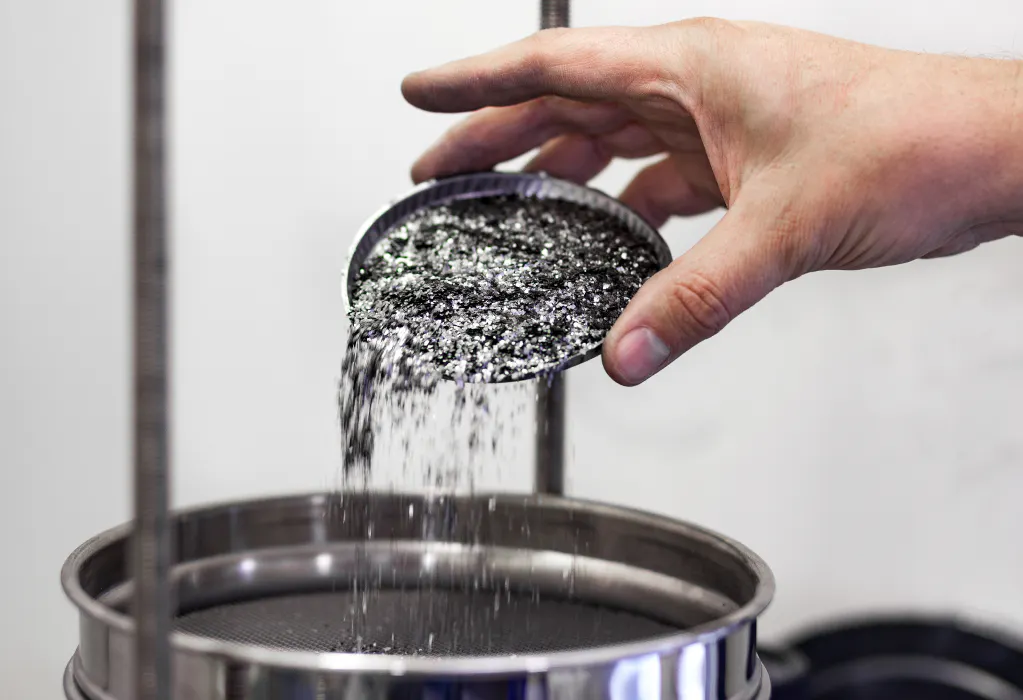
If expandable graphite is the flame retardant of choice, it is mixed into the polyol formulation and processed in the foaming machine’s mixing head. This is exactly where the real challenge begins.
The technical challenge of high-pressure processing
PU foams are formed through a chemical reaction between two components, polyol and isocyanate, which are mixed in a precise ratio. This can be done mechanically (low-pressure) or using counterflow nozzles (high-pressure). While low-pressure mixing is typically used for block foam, high-pressure mixing is the standard for moulded foams like train seats or engine covers. It enables complex part geometries, shorter cycle times, and more efficient material use, making it indispensable for many industrial applications.
But adding expandable graphite as a flame retardant additive to this process requires specialist know-how. Despite its outstanding fire protection performance, expandable graphite is a highly sensitive material. Its effectiveness depends on each individual flake remaining intact. This becomes challenging during high-pressure methods. The combination of high shear forces and recirculation at the mixing head can break the graphite flakes and release the sulphuric acid stored within. This directly affects both process and product:
- Catalysts in the polyol are neutralised and damaged
- Machine components corrode
- The flame retardant effect is reduced
Previous Approach
A reduced flame retardant effect due to broken expandable graphite flakes forces manufacturers to overdose to meet standard compliance. This drives up costs and component weight, without addressing the real problem.
The Future-proof Solution
Proper processing, as with the EG-AX system, allows the graphite to be processed so gently that the flame retardant effect remains fully intact and precise, standard-compliant dosing is possible.
Cannon’s solution: The EG-AX system
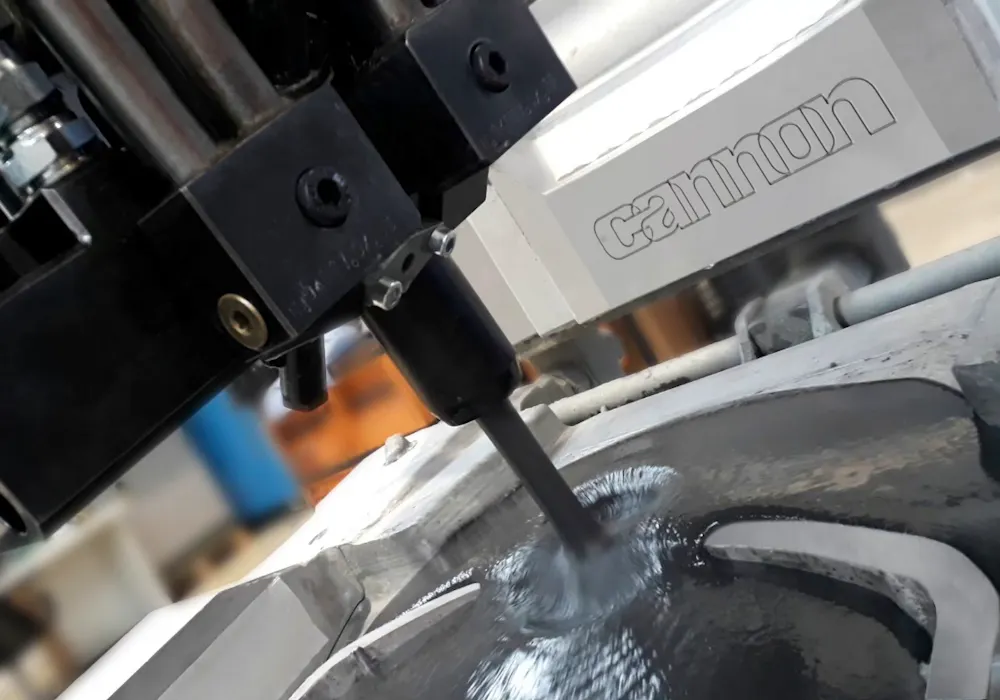
With the patented mixing head of the EG-AX system, Cannon has developed a reliable solution that enables safe and efficient processing of expandable graphite, even under high pressure. The system was publicly introduced for the first time in 2021, opening new opportunities for more sustainable PU production. The machine manufacturer focused on minimising the shear stress and the time the EG-polyol mixture flows through the injector at the mixing head.
The Cannon EG-AX system features a patented multicomponent mixing head available in different sizes. With four separate flows, it is specifically tailored to the requirements of expandable graphite processing:
- Stream 1 supplies the blend of polyol and expandable graphite
- Streams 2 and 3 supply isocyanate, fed from a single pump and split by a flow divider
- Stream 4 is an optional inlet for additives or blowing agents
Equipped with a special flow distributor and injector, the mixing head drastically shortens the high-pressure recirculation time. This significantly reduces the shear strain on the expandable graphite flakes and keeps the formulation stable in the foaming machine up to three times longer than in conventional systems.
GHL PX 98 HE: Proven in Practice
Testing with LUH’s expandable graphite GHL PX 98 HE ensured that flake damage could be avoided and that manufacturers can use precisely the right amount of expandable graphite in the formulation to pass fire safety tests. The EG-AX system is based on two concepts for reducing mechanical stress on the flakes:
- Innovative injector geometry: The polyol-expandable graphite slurry flows through specially engineered injectors that reduce shear forces on the sensitive flakes. This preserves flake integrity and expandability.
- Fast mixing pressure control: A precisely tuned valve and actuator system achieves the required mixing pressure in just 0.9 seconds. This drastically shortens the high-pressure recirculation time, dramatically reducing the primary cause of flake damage.
Insights for the Future
The Cannon EG-AX technology is already in use in several industries and demonstrates the wide range of applications for expandable graphite in high-pressure processing. As well as train seat foams (EN 45545) and integral foam engine covers (UL 94 V-0), further applications include furniture and upholstery components (BS 5852 Crib 5/7), insulation panels (EN 13501-1) as well as sound-dampening parts and household appliance insulation.
The collaboration between LUH and Cannon proves that high-pressure processing of expandable graphite in PU systems is not only technically possible but can be implemented reliably at industrial scale. Strict international fire safety standards have been successfully met under real production conditions.
And with mounting regulatory pressure on halogenated flame retardants, demand is growing for reliable, halogen-free alternatives. Expandable graphite is that alternative. Thanks to this project, we can ensure the material is not only available, but can also be processed reliably under industrial high-pressure conditions, meeting the strictest fire protection requirements.
For LUH, this means more than just supplying materials. We see ourselves as a development partner who contributes ideas from the raw material to the completed application and actively shapes tomorrow’s fire protection.